
Last updated: 10 November 2026 · 6 min read
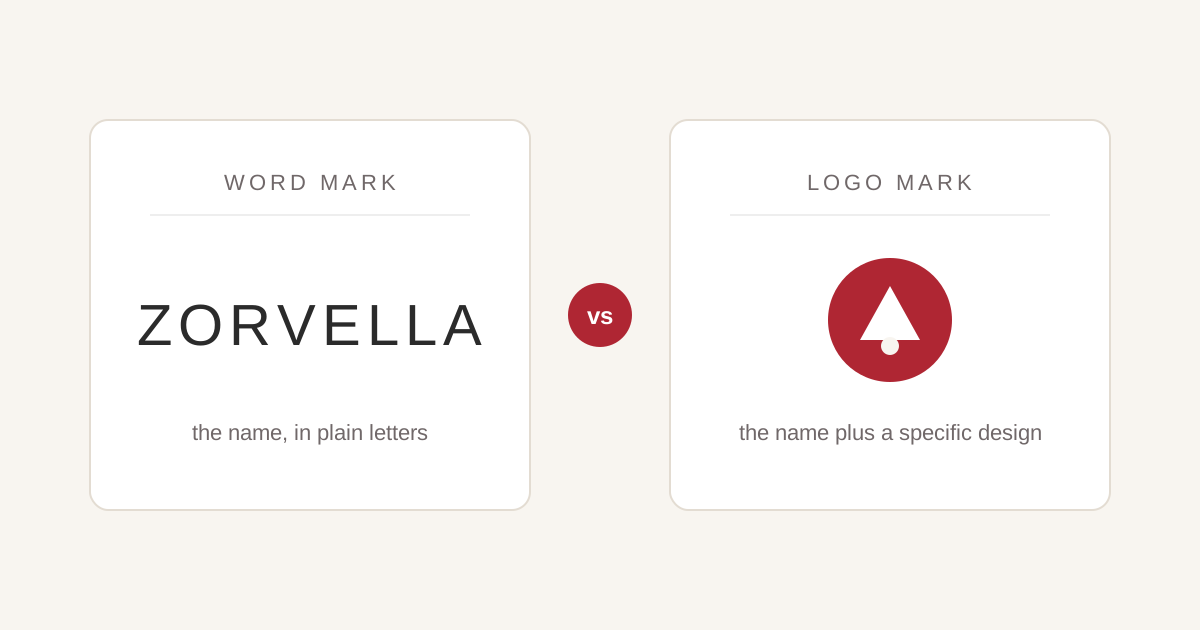
If you can only pay for one trademark application this year, make it the name. That holds for most small businesses. Not all of them, though, and the exceptions are common enough that it's worth checking whether you're one.
The question tends to come up at a bad moment. The designer has just sent the final logo files, the first batch of packaging is booked with the printer, and somebody in the family WhatsApp group says you should "get the trademark done". Done for what, exactly? The name, the logo, or both. They're separate applications, and they don't protect the same thing.
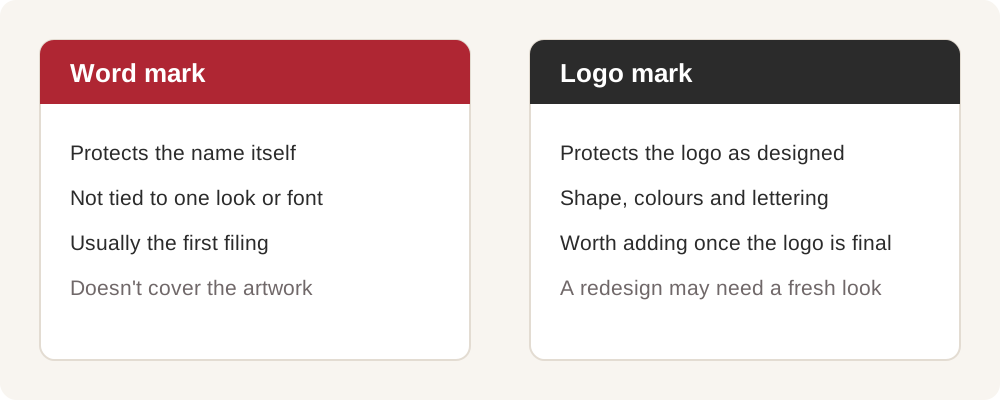
A word mark is the name on its own, in plain characters. No font, no colour, no icon. Once it's registered, your rights attach to the word, so they generally follow the name wherever it shows up and however it's styled: on a label, a website banner, the side of a delivery van.
A logo mark (the Registry calls it a device mark) protects the mark as you've drawn it. If your logo has the name sitting inside a design, the application covers that combination, meaning the lettering, the shapes, and the colours if you've claimed them. That's narrower than most people expect.
Here's how it plays out. Say you sell cold-pressed oils under a made-up name, Tilvana, and your logo is the word in a curved green script above a drawing of a sesame pod. A competitor launches "Tilvaana" in blocky orange capitals, no sesame pod anywhere. If you hold a word mark for Tilvana, your complaint is easy to state: a name that sounds the same, on the same goods. If you hold only the logo, you're arguing that their name resembles the word element inside your design. That argument can still succeed. It's just a longer conversation, and the outcome is harder to predict.
If you're still fuzzy on what counts as a trademark in the first place, our plain-English explainer covers the basics.
Customers ask for things by name. They type it into a search bar, say it over the phone to a distributor, write it in a one-star review when the bottle leaks. The name travels to places the logo never reaches.
Names also outlive logos. Small businesses redraw their logos every few years, sometimes sooner, once there's money for a proper agency or a co-founder with opinions. A registered logo protects the version printed on the certificate. Change it substantially and the new version will generally need its own application. Your word mark doesn't care how many times you redesign.
And the word mark is the honest test of whether your name is available. When an examiner checks your application against earlier marks under Section 11 of the Trade Marks Act, 1999, a conflict over the name is usually what causes the trouble. You'd rather find that out on the filing that matters most.
There's a related trap. If the name is the sort that gets objected to under Section 9 (typically because it simply describes the product), wrapping it in a nice logo might get the overall design registered, often on the condition that you claim no exclusive right in the descriptive word. So you end up with a certificate that looks good on the wall and stops very little. Founders sometimes file a logo precisely to sneak a weak name past the Registry. It rarely does what they hoped.
There are genuine reasons to file the logo early, or even first. The ones that come up most:
That third case deserves a closer look. Take a hypothetical juice brand called "FreshPress". For juice, that's close to a description. The logo may be the only part of the branding the Registry is willing to treat as distinctive, so filing it is a reasonable fallback while the business builds the kind of reputation that might later support the name. But if the name is that weak, it may be cheaper to change it before launch than to defend it for years. Our post on choosing a brand name that can clear a trademark search goes into this in more detail.
One more thing, which isn't strictly a trademark point. Whoever designed your logo, freelancer or agency, may own the copyright in the artwork unless they've assigned it to you in writing. Get that assignment signed before you file for the logo. It's a short document, and chasing a designer for it three years later is not fun.
Government fees in India are charged per application, per class. A word mark and a logo mark are two applications, so filing both in two classes means paying the official fee four times, plus whatever your professional charges for each. The current figures are in our guide to trademark registration cost, and they change from time to time, so check before you budget.
Dates matter more than most people realise. Between two competing applications for similar marks, the one filed earlier generally starts from the stronger position on the register. Genuine earlier use of a mark can change that picture, which is a topic of its own and covered in our post on what protection you have without registration. So holding back the word mark to save money is a poor saving if your name is already public and someone else could file ahead of you.
Holding back the logo is a smaller risk. A later logo application doesn't weaken a word mark you've already filed.
A lot of founders land on a staggered plan: the word mark now, in the classes that cover what they actually sell, then the logo a few months later once the design has settled and some revenue is coming in. That's usually fine. What to avoid is the reverse, a logo rushed through while the name sits unprotected.
Start with a search, before any of this. Run the name through our free trademark search and use the Class Finder to work out which classes you need. If the search throws up close matches in your class, the name-versus-logo question drops down the list, because you may have a naming problem to solve first.
If the search is clean and the name isn't descriptive, file the word mark first. Add the logo once it's final and you expect to keep it for a while.
If the name leans descriptive, or the search shows a crowded field of similar names, talk it through with someone before you spend on either filing. A logo application might help you. Or the straight answer might be a different name.
And if the budget stretches to both from day one, filing both is perfectly sensible, especially for consumer products where the packaging does a lot of the selling. Just don't let the logo stand in for the name.
So: search the name in the class you actually trade in, read what comes back carefully, and file the word mark if it's clear.
Generally, yes. A word mark is filed in plain characters, so the protection attaches to the word itself rather than one particular way of writing it. How far that goes in an actual dispute depends on the facts, including how similar the other mark is and what goods it's used on.
You can, and plenty of people do. The catch is that a combined (composite) mark is compared as a whole, so it's usually a less direct way to protect the name on its own than a separate word mark.
Small tweaks may not matter much, but a substantially different logo generally needs a fresh application. A redesign doesn't touch your word mark, which is one reason the name is usually the better first filing.
The safe practice is to use the registered symbol only with the mark exactly as it's registered. If only the word is registered, put it next to the word and use TM on the logo until the logo is registered too.
