
Last updated: 10 November 2026 · 6 min read

You do have rights in a trademark you never registered. They're just harder to use.
Plenty of businesses trade for a decade on a name they never filed, and nothing goes wrong. Then a competitor opens two streets away with a name that sounds almost the same, customers start mixing the two up, and the owner discovers that "we've been using it for years" is the start of an argument, not the end of one.
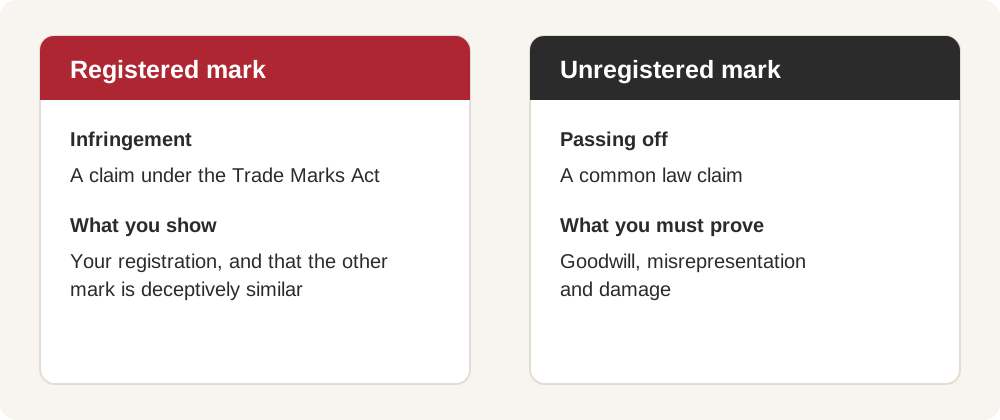
Indian law gives a trademark owner two different kinds of claim, and which one you can bring depends on whether your mark is registered.
Infringement is a statutory claim under the Trade Marks Act, 1999. Registration gives the owner an exclusive right to use the mark for the goods or services it's registered for, and infringement is the remedy when someone else uses an identical or confusingly similar mark without permission. It's only open to registered marks. Section 27 says so directly: nobody can sue to prevent or recover damages for infringement of an unregistered trademark.
But the same section also preserves the older remedy. Nothing in the Act affects anyone's right to sue for passing off. That's a common law action, and it's what protects an unregistered mark.
So you aren't defenceless. You're just on the harder of the two routes. (If you have a registered mark, you can and often would bring both claims together.)
Passing off protects the goodwill in your business against someone who misleads the public into thinking their goods or services are yours, or connected to you. Courts usually break it into three things you have to establish.
First, goodwill. You must show that your name or logo has come to be associated in the minds of the relevant customers with your business specifically. Having used it isn't enough on its own. People have to recognise it as yours.
Second, misrepresentation. The other side's use must be likely to lead customers to believe their goods or services come from you, or are linked to you. They don't have to have done it deliberately, though evidence that they copied on purpose rarely hurts your case.
Third, damage, or a real likelihood of it. Lost sales, customers drifting to the other business, harm to your reputation when their product disappoints.
Here's a hypothetical. A bakery in Kochi has sold cakes as "Malabar Crumb" for eight years. A new outlet opens nearby as "Malabar Krumb", same style of signage, same kind of cakes. If the first bakery never registered its name, it can't sue for infringement. It would have to show that its name had built up goodwill locally, that the new name was likely to confuse buyers, and that it was suffering or likely to suffer harm. Quite possibly winnable. But each of those points needs proof.
Goodwill is the hard part. It's a question of fact, and you prove it with paper: dated invoices, sales figures, advertising spend, press mentions, social media history, sometimes statements from customers or traders. A business that kept good records and has been visible for years may have plenty. A two-year-old brand that sells mostly through Instagram DMs may struggle.
Goodwill also has edges. It can be limited to a locality, a customer segment or a type of product. If your bakery is known in one city and the copycat opens in another state, showing goodwill among customers there gets a lot harder.
And you prove all of it again, from scratch, in every dispute. More evidence means more preparation and more of your lawyer's time, and usually a longer fight.
Compare that with a registered mark. The registration itself is generally treated as prima facie evidence that the mark is valid, so in an infringement case you start from the certificate. You still have to show the other side's mark is identical or deceptively similar and used for the relevant goods or services. But you don't usually have to prove you've built a reputation first. That's a much shorter story to tell a court, and often a shorter story to tell the other side in a legal notice, which is where a lot of these disputes end.
Being unregistered doesn't mean a later filer can simply take your name. The Act protects the vested rights of a prior user: broadly, a registered owner can't stop someone who has been continuously using a similar mark for the same goods or services from a date earlier than the registered owner's own use or registration.
Prior use can also be the basis for opposing someone else's application when it's published, or for seeking to remove a registration that shouldn't have been granted. The difference between those two procedures is set out in our guide to objection vs opposition. In practice, though, you're on the back foot. You only find out when you happen to spot the application, and you're spending money defending a position you could have secured by filing.
While you're unregistered, you can use the TM symbol next to your name. Don't use the registered symbol until registration is actually granted; misrepresenting a mark as registered is an offence. The rules are in our guide to trademark symbols.
Not every name needs filing on day one. A one-off event name, a product you're testing for a season, a project you might shelve: it's reasonable to wait and see.
But registration starts to earn its cost quickly once any of these apply. You plan to sell beyond your own city, especially online. You want to license the name, franchise it or bring in investors, who will usually ask what you own. You're putting real money into packaging and marketing. Or your name is the sort a competitor might plausibly copy.
A registration lasts 10 years from the application date and can be renewed for further 10-year periods. Against the cost of proving goodwill even once, that's usually a sensible trade. Our post on whether to register the name or the logo first helps you decide what to file, and if you're still settling on a name, read how to pick one that can clear a search before committing.
If you've been using your name for a while, start by pulling together dated proof of first use: early invoices, old packaging, your first social posts. Then run the name through our free trademark search to see whether anyone has filed something close in the meantime.
Not for infringement under the Trade Marks Act, 1999, because that action is only available to registered marks. You can bring a passing off action, but you'll need to prove goodwill, misrepresentation and damage.
Yes. TM simply signals that you treat the name or logo as your trademark. The registered symbol is different: use it only once the mark is actually registered, because falsely representing a mark as registered is an offence under the Act.
Not necessarily. An earlier user of a mark can have rights against a later filer, and there are procedures for opposing an application or seeking to remove a registration. Deadlines apply, so get advice quickly.
No. You can still apply, and the application lets you state the date you first started using the mark. Gather dated evidence of that use before you file.
