Last updated: 10 November 2026 · 6 min read
The names founders love most are often the ones the Trade Marks Registry likes least. A name that tells customers exactly what you sell feels smart on a pitch deck. To an examiner it can look like a plain description of the goods, and descriptions belong to everybody.
So the first rule is slightly counterintuitive. The more a name explains, the harder it usually is to own.
Section 9 of the Trade Marks Act, 1999 sets out what the Act calls absolute grounds for refusal. One of them covers marks made up only of words that describe the kind, quality, quantity, intended purpose, value or geographical origin of the goods or services. Another covers words that have become customary in the trade.
Say you're launching a millet snack and want to call it "Crunchy Millet Bites". Every word in that name describes the product. You'd struggle to register it, and even if some version got through, you couldn't realistically stop a competitor from describing their own millet snack as crunchy. Which is, after all, what the word is for.
Laudatory words fall into the same hole. "Best", "Super", "Premium", "No. 1". They praise the goods without telling anyone who made them.
There is an escape hatch. A name that would otherwise be refused can still be registered if it had acquired a distinctive character through use before you applied, or is well known. But that means proving it with evidence of sales, advertising and public recognition, usually over a long period. A brand that hasn't launched yet has none of that. Picking a better name costs far less.
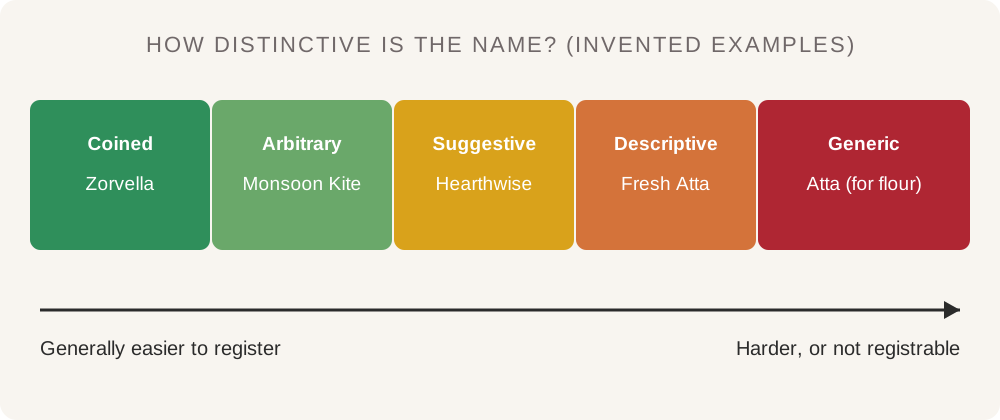
Practitioners often sort names along a rough scale, from strongest to weakest. It's a working tool rather than a test written into the Act, but it's a useful way to sanity-check a shortlist. Using made-up examples:
Most founders end up somewhere around suggestive, and that's fine. It's the sweet spot for a lot of small businesses, because the name gives customers a clue without simply naming the product. The problem is that the line between suggestive and descriptive is blurry, and examiners don't always draw it where you'd like. If you find yourself writing a paragraph to explain why your name isn't descriptive, it probably is.
Coined names have their own cost. Nobody knows what "Zorvella" means, so your marketing has to teach them. Some businesses decide that's a fair price for a name they can actually protect. Others don't.
A distinctive name can still fail if it's too close to someone else's. Under Section 11, the Registry can refuse a mark that's identical or similar to an earlier mark for the same or similar goods or services, where that's likely to confuse the public. Earlier marks with a strong reputation can be protected even beyond their own goods.
Similarity isn't judged letter by letter. It's about the overall impression, and it runs along a few lines at once. How the name sounds matters a great deal in India, where people say brand names aloud in several languages and spell them however feels natural. "Kaapi Kraft" and "Coffee Craft" look different on paper. Read them out and the problem is obvious, and they mean nearly the same thing too.
Visual similarity counts as well: shared prefixes, a swapped vowel, the same unusual letter pattern. Meaning can matter, including translations of the same idea between languages.
Then there's the goods side. Two identical names can sit side by side on the register if one is for cement and the other for ice cream. Two fairly similar names for the same kind of product often can't. Classes help here, but they're an administrative grouping. Goods in different classes can still be related closely enough to cause a conflict, so don't treat "different class" as an automatic green light. Our guide to trademark classes explains how the 45 classes are organised.
This is the step people skip. They pick a name over a weekend, buy the domain, brief a designer, and only search the register once the logo is done. By then they're emotionally invested, and a bad search result feels like a disaster instead of what it should be: a cheap, early correction.
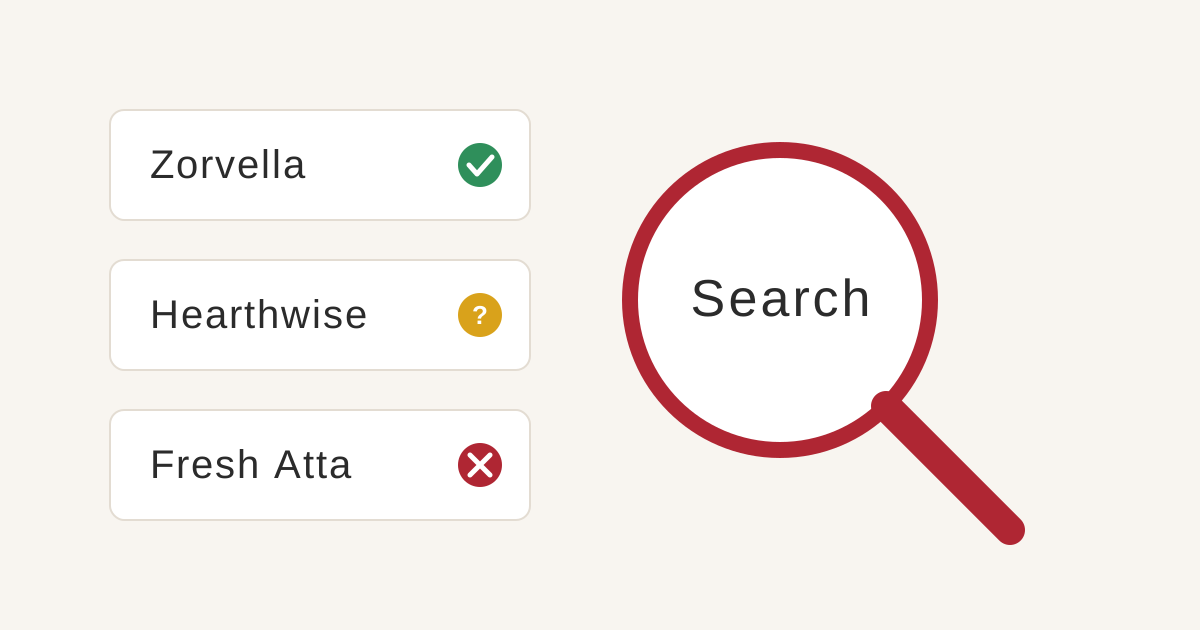
Search early, and search in the right place. Use the Class Finder to work out which classes your goods or services fall in, then run each shortlisted name through our free trademark search. Look for exact matches, but also for names that sound alike, share the distinctive part of your name, or differ by a letter. Check the status of anything close. A pending application can block you just as a registered mark can.
Also look outside the register. Search marketplaces, Instagram and Google for businesses already trading under the name. Someone who has been using a name for years without registering it may still have rights that can cause you trouble, which we explain in our post on unregistered trademarks.
A clean free search doesn't mean the name is safe. It means you haven't found an obvious problem yet. A proper search report and an opinion on the results is the next layer, and it's worth getting before you spend serious money on the brand.
Founders often check the .com and the Instagram handle first, because it's quick and it feels like progress. It tells you very little about the trademark. Registrars don't check the trademark register, so an available domain isn't a green light. And a taken domain doesn't always rule a name out either; plenty of domains are parked by people who'll never use them.
Treat domains and handles as a tiebreaker. Once you have two or three names that look clear on the register, pick the one where you can get a sensible domain and consistent handles. Doing it the other way round is how people end up attached to a name that can't be registered, simply because the .com was free.
One related point. If you settle on a name, register the word itself as a trademark before you put money into the logo. The reasons are in our piece on whether to file the name or the logo first.
For now, shortlist three or four names, search each one in the class you'll trade in, and cross off any that come back with close matches before you get attached to them.
Possibly. The Act allows a mark that would otherwise be refused as descriptive to be registered if it has acquired a distinctive character through use before the application date. You'd need solid evidence of that use, and there's no guarantee the Registry will accept it.
No. Domain registrars don't check the trademark register. A free domain tells you nothing about whether someone already has rights in the name for your kind of goods or services.
Often, if the goods or services really are unrelated. But classes are an administrative grouping, so related goods in another class can still cause a conflict, and marks with a strong reputation can get wider protection. Get the result checked before you commit.
It depends on what you sell. An ordinary word used for something it has nothing to do with can be quite distinctive. A place name that suggests where your goods come from is likely to draw an objection.
