Last updated: 10 November 2026 · 7 min read
Typing your brand name into a search box and getting no exact match feels like a green light. Usually it isn't one. Exact matches are the easy part. The marks that cause real trouble are the ones that look a little different on screen and sound identical when someone says them across a shop counter.
So before you search anything, it helps to be clear about what you're searching for.
What you are actually checking
The Trade Marks Act, 1999 doesn't ask whether your name is unique. Broadly, the question under Section 11 is whether your mark is identical or similar to an earlier mark, for goods or services that are the same or similar, in a way that's likely to confuse the public. The name and the goods get weighed together. You can't check one without the other.
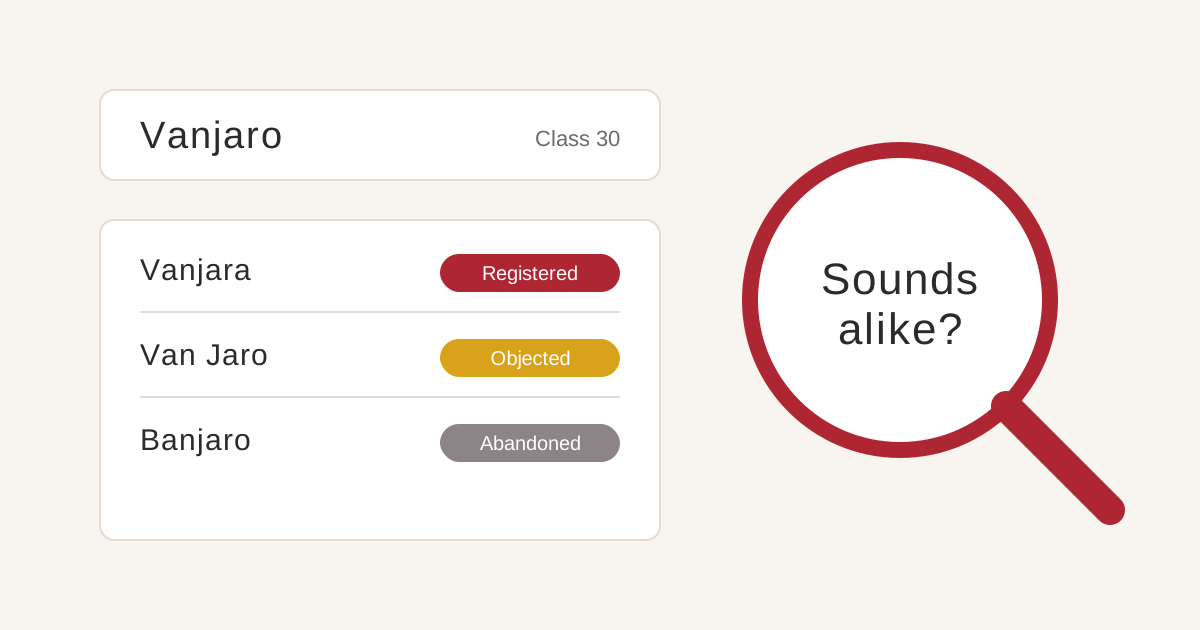
Take a made-up example. You want to sell cold brew coffee as "Vanjaro". Someone already has "Vanjara" registered for tea. Different spelling, but it sounds almost the same, and tea and coffee are close neighbours (both sit in class 30). That's a problem. Now suppose the earlier "Vanjara" is registered for tyres instead. Same sound, completely unrelated goods. Much less likely to be a problem, though a very famous mark can be protected well beyond its own products.
This is why the class matters so much. India follows the Nice classification, which splits goods and services into 45 classes. If you don't know which ones you belong in, the Class Finder is a quick way to get a first answer, and our guide to trademark classes explains how they're organised. But don't stop at your own class. A coffee brand that also plans to run a cafe is looking at a services class too, and an earlier mark there can matter.
Searching the official register
The place to start is the Trade Marks public search on the official IP India website. It's the Registry's own record of applications and registrations, and anyone can use it.
You'll generally search by word mark, choose a class, and pick how the system should match your term. The portal has offered options along the lines of "starts with", "contains" and a phonetic search, though the exact choices can change, so check what's on the screen when you use it. Use more than one. A "contains" search on the most distinctive chunk of your name often turns up things an exact search misses.
Then try the variations a customer might produce. Swap vowels. Double or drop a letter. Split the word in two, or join two words into one. Try it in Hindi or another language if the name has a meaning there, and try how it might be spelled by someone who has only heard it said aloud. For "Vanjaro" that means "Vanjara", "Van Jaro", "Wanjaro", "Banjaro" and so on. It's tedious. It's also where most of the useful results come from.
Logos are harder to search than words, and that's worth knowing before you spend weeks on a design. If the logo carries your name, the word search does a lot of the work anyway.
Our trademark search page has more background on searching, and if you'd rather not do it yourself, our team can run a search for you.
Looking outside the register
Plenty of businesses in India trade for years without ever filing. They don't show up on the register at all, but they can still have rights in their name based on use, and a passing off claim from an earlier user is a real risk. Our post on what protection you have without registration explains how that works. For your search, it means a quick look around the market:
- Google the name with words describing your product, and look past the first page.
- Search the big marketplaces in your category.
- Instagram and Facebook, since a lot of small brands live there and nowhere else.
- The domain, mostly to see whether someone is actively using it, because a free domain tells you nothing about the trademark position.
If you find a small business in your city selling the same kind of thing under a near-identical name, take that seriously even if they've never filed anything.
Reading what comes back
Each result on the register has a status, and the status changes how much it should worry you.
Registered is the obvious one. A live registration for a similar mark in your class or a related one is the strongest obstacle you can find. Don't assume a registration has lapsed just because it's old. Check what the record actually says.
Pending covers applications still working their way through examination, publication and the opposition period. People tend to brush these off. They shouldn't. A pending application has an earlier filing date than yours, and if it registers it can be cited against you.
Objected means the examiner raised concerns in the examination report. The applicant usually has 30 days to reply, and plenty of objected marks go on to registration, so an objection isn't a sign the mark is dead. Our post on what an objected status means goes through this, and the objection and opposition guide covers the difference between the two.
Abandoned, withdrawn, refused or removed marks are generally less of a barrier on the register. Generally. A removed registration can sometimes be restored, and the business behind an abandoned application may still be trading under the name. So it comes back to the market check.
Once you know the status, look at the mark itself. Similarity is judged on the overall impression: how it sounds, how it looks, and what it means. In India, sound carries a lot of weight because brand names get said aloud in many languages and spelled however feels natural. Shared prefixes, a swapped letter, the same distinctive syllable. We've written more about this in what happens when someone has a similar name.
What a clean search does not prove
Say you've done all of the above and found nothing close. Good. But be honest about what that means. It means you haven't found an obvious conflict. That's different from the name being clear.
A search is only as good as the variations you tried, and recently filed applications may not show up straight away. Unregistered users can be invisible to a quick look. And a search only tells you about other people's marks. It says nothing about whether your own name will get past the examiner on its own merits. Descriptive names (think "Fresh Brew" for coffee) tend to draw an objection under Section 9 of the Act even when nobody else owns anything similar. If that sounds like your shortlist, read our piece on picking a brand name that can clear a search first.
None of this is a reason not to search. It's a reason not to treat a free search as a guarantee. Nobody can give you one of those, including us.
When to get someone else to look
You can do a perfectly sensible first pass yourself. Where a second pair of eyes earns its keep is in judgement. Is that mark in class 29 close enough to your class 30 product to matter? Does "Vanjara" for tea block "Vanjaro" for coffee, or could you argue your way past it? Those calls depend on the goods, the marks and how examiners tend to treat them, and they're hard to make about your own name.
It's worth getting help if you found anything close and can't decide whether it matters, if you're about to spend real money on packaging, stock or a launch, or if you trade across several classes. A proper search with an opinion on the results costs far less than renaming a product after it's on shelves. Our team can run a search and talk you through what it shows; get in touch with the name and what you plan to sell.
If you want to do the first pass today, open the IP India site, search your name and four or five spelling variants in your main class, and write down anything close along with its status. That list is what you'll want in front of you before you file.
Frequently asked questions
-
Can I search the trademark register myself?
Yes. The Trade Marks public search on the official IP India website is open to anyone. It takes some patience, because you need to try spelling variations and pick the right classes, and the results still need reading carefully. If you'd rather not, a professional can run the search and give you an opinion on what comes back.
-
Someone has applied for a similar name but it isn't registered yet. Does that matter?
It can. A pending application has a filing date, and if it goes on to registration it can be raised against a later application for a similar mark. Treat a pending mark in your class as a real obstacle until you know more about it.
-
The closest match I found is marked abandoned. Am I in the clear?
Not automatically. An abandoned application is usually less of a problem on the register, but the business behind it may still be trading under that name and could have rights from that use. Check whether the name is still out there in the market before you rely on it.
-
Do I need to search all 45 classes?
Usually not. Search the classes that cover what you actually sell, plus any that cover closely related goods or services. Very well-known brands can be protected beyond their own classes, so a famous name is worth avoiding whatever class it sits in.
